GLM-5.4 on the Coding Plan: Architecture, Quotas and Setup
Explore GLM-5.4’s coding results and Loop Transformer design, see who gets the 1.5× token allowance, and configure Claude Code, Cline or ZCode.
 PicoX TeamPublished
GLM-5.4 arrived on November 23, Beijing time. If you already have a GLM Coding Plan, you can open your editor, select it and give it a screenshot alongside the code you want it to change. The release reached ZCode, Trae, WorkBuddy, Qoder and OpenCode, as well as Z.ai Chat. At launch, Z.ai said the general-purpose API would follow a safety review and that it planned to release the weights. As of November 24, PicoX lists GLM-5.3, GLM-5.3-Flash and GLM-5.3-FlashX. We plan to add GLM-5.4 once the official API opens. Z.ai release announcement · PicoX model catalog
What GLM-5.4 did well in the coding tests
Z.ai evaluated the model on 200 real-world coding scenarios. Its report highlights tasks that need both code and a good eye, such as recreating a design from a reference and carrying a series of edits through to a working result. Each row below shows how often GLM-5.4 won, tied or lost in the developer's evaluation. Official evaluation and results chart
| Compared with | Win | Tie | Loss |
|---|---|---|---|
| GLM-5.3 | 51.1% | 25.7% | 23.1% |
| Kimi K3.1 Pro | 41.8% | 26.9% | 31.3% |
| DeepSeek-V4.1-Flash-1017 | 36.6% | 30.2% | 33.2% |
The largest margin is against GLM-5.3, at 28 percentage points between wins and losses. Against DeepSeek the margin narrows to 3.4 points. To see what the visual work looks like, watch the release demos. One uses code to draw each frame of a music video and a separate music model for the soundtrack. Another builds an interactive 3D bird from geometry and shaders. A third models a six-axis arm in FreeCAD and animates its grasp in Blender. Z.ai's three demonstrations
Z.ai describes the model as operating at the 750-billion-parameter scale and compares its capabilities with models in the two-to-three-trillion range. That second number is the team's performance comparison. For its own serving infrastructure it reports up to 200 output tokens per second off peak and 70–80 at peak load. A customer measuring time to the first token is measuring something different. Architecture and serving measurements
Why 28 layers run twice
GLM-5.4 uses a Loop Transformer. During one forward pass it sends the intermediate representation through the same block of 28 layers twice. The second pass can refine the first pass's result using weights already in memory. Three engineering choices make this practical at a million tokens of context. Technical report
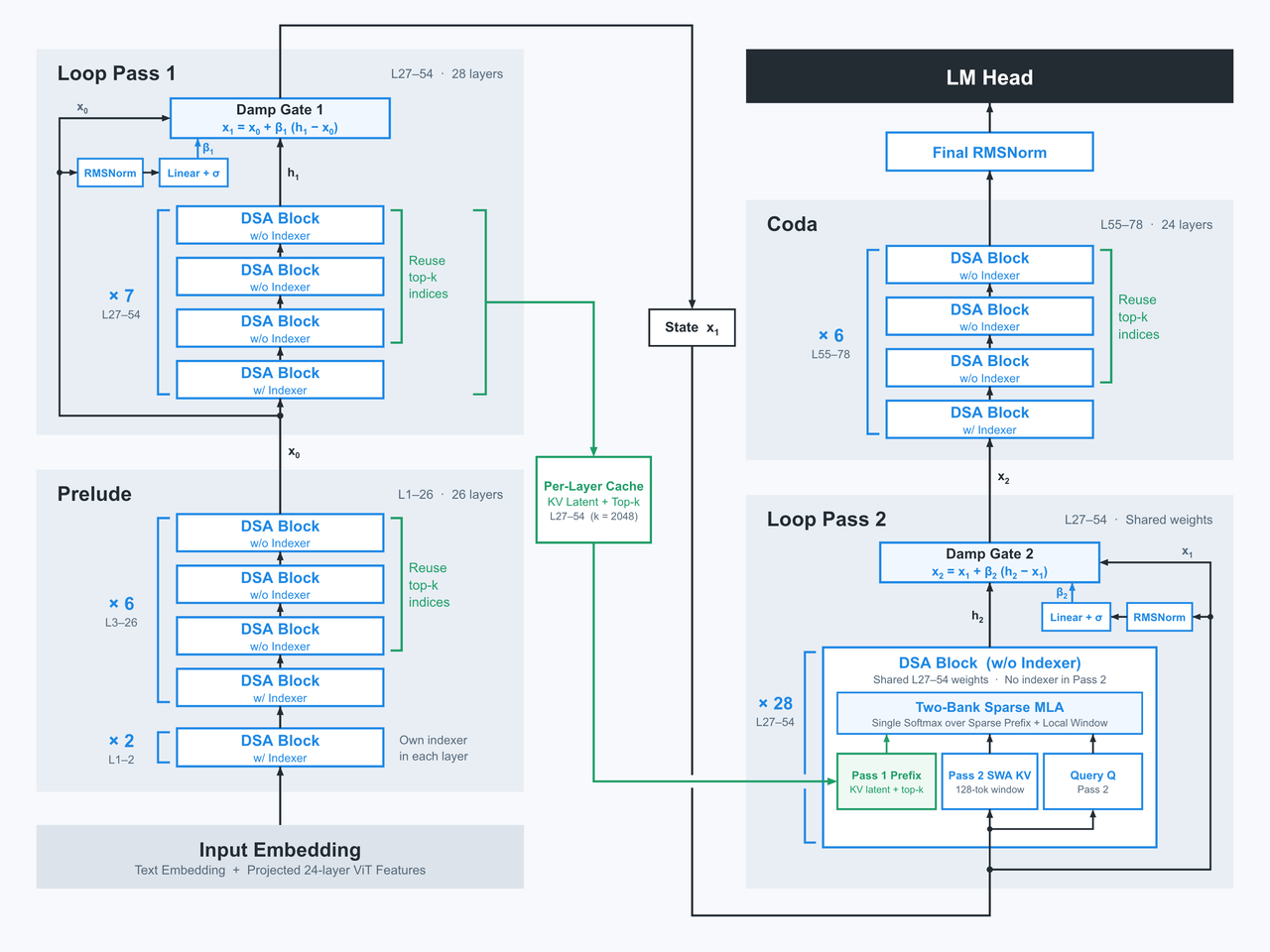
- Each pass controls how much it changes. A gate at each token decides how much of the new result to add back. The team observed that the first pass generally makes smaller updates, while the second does more of the refinement.
- The long-range cache is shared. The second pass reads keys and values selected by the first and keeps a separate sliding window of fresh local values. The extra cache grows with that window.
- The attention lookup runs once. Both passes use the same sparse attention indices, which saves the cost of finding relevant positions a second time.
The team tested looping at 1B, 4B, 30B and 750B scale. One particularly informative experiment held the parameter count fixed at 30B. With about 10% more training compute, the looped model produced 10–14% shorter answers on several benchmarks, including GPQA and MMLU-Pro. That finding belongs to the 30B experiment. The team also observed that the released flagship can spend a long time reasoning, so the effort setting is worth learning. Controlled experiments and observed limitations
Which plans get the extra quota?
On eligible plans, an allowance that bought 100,000 tokens with GLM-5.3 buys 150,000 with GLM-5.4. The multiplier applies to tokens. A large tool result or a lengthy reasoning pass can still change how many tickets you finish before the next reset. ZCode quota FAQ
| Plan | GLM-5.4 access | Allowance |
|---|---|---|
| V2/V3 Lite, Pro and Max | Included | 1.5× the usable GLM-5.3 tokens for the same quota |
| Team | Included | The same 1.5× rate |
| Legacy V1 | Included | Existing V1 terms |
| ZCode Start Plan | Five-day trial for eligible new users | 3 million GLM-5.4 tokens per day during the trial |
The BigModel guide lists a separate daily allowance of 5 million GLM-5.3-Flash tokens for the same five days. The trial works inside the official ZCode app. Check your account’s Start Plan page for eligibility and current allowances. The separate, temporary ZCode quota bonus has ended. You can still choose GLM-5.3 or GLM-5.3-Flash. Existing sessions keep their selected model, and the release included no GLM-5.4 Flash variant. Start Plan details · Model availability and previous promotions
Configure your coding client
If you use ZCode's account connection, signing in with the account that holds the subscription takes care of routing. For a manually configured client, pick the service region where you bought your plan and the protocol your tool expects. The general OpenAI-compatible route, /api/paas/v4, bills against API resources. The Coding Plan has its own address. Connection guide
| Account region | Anthropic-compatible Coding Plan | OpenAI-compatible Coding Plan |
|---|---|---|
| International (Z.ai) | https://api.z.ai/api/anthropic | https://api.z.ai/api/coding/paas/v4 |
| Mainland China (BigModel) | https://open.bigmodel.cn/api/anthropic | https://open.bigmodel.cn/api/coding/paas/v4 |
Claude Code
With an existing Coding Plan connection, merge these entries into env in ~/.claude/settings.json (on Windows, %USERPROFILE%\.claude\settings.json). The three model mappings send each Claude Code alias to GLM-5.4. The [1m] suffix and compaction setting enable the full context window. If Claude Code cannot find that model name, update the client first. Restart Claude Code, run /status to check the active model and settings file, and use /effort to change the reasoning level. Model-switching guide
{
  "env": {
    "ANTHROPIC_DEFAULT_HAIKU_MODEL": "glm-5.4[1m]",
    "ANTHROPIC_DEFAULT_SONNET_MODEL": "glm-5.4[1m]",
    "ANTHROPIC_DEFAULT_OPUS_MODEL": "glm-5.4[1m]",
    "CLAUDE_CODE_AUTO_COMPACT_WINDOW": "1000000"
  }
}
If a client supplies an explicit effort setting, it takes priority over its thinking switch. Claude Code uses output_config.effort and thinking.type. Codex uses reasoning.effort. The following mappings explain why switching thinking off can still leave a brief reasoning step. Effort mappings
| Client setting | Values | GLM level |
|---|---|---|
| Explicit effort | minimal, light, low | Low |
| Explicit effort | medium, high | High |
| Explicit effort | xhigh, max, ultra, or an unrecognized string | Max |
| Thinking switch alone | false, disabled, none, off | Low |
| Thinking switch alone | Omitted, true, enabled, adaptive | Max |
Cline
In Cline, choose OpenAI Compatible, enter the Coding Plan URL and key, then set the custom model to glm-5.4. Enable Support Images for screenshot input and enter 1000000 for the context window. Cline configuration
ZCode
In ZCode, select GLM-5.4 in the model picker beside the message box. If the entry is missing, update ZCode, open Settings → Model settings and choose Refresh. The effort control cycles through Low, High and Max with Ctrl+T. Max is the default. At the usual settings ZCode begins compacting near 966,000 tokens. From the full million, it reserves up to 21,000 for output and about 13,000 as a safety margin. ZCode model picker and context settings
Three ways to try it on your own code
For a change that crosses a UI, a persistence layer and an API, I'd keep Max and ask for the smallest test that fails on the current commit. A passing test after the patch is easier to review when you've already seen exactly how it failed. For a rename or a one-line copy edit, start on Low.
For visual work, give it the reference image and a concrete acceptance test. “At 390 pixels wide, the purchase button and its price must both fit on screen” says more than “make this responsive.” Ask for a screenshot at that width alongside the change.
Finally, pick two or three recent tickets from your own team and start both models on the same commit. Count the cases where the tests pass, the patch is small enough to review and nobody has to repeat an instruction. Record the tokens or quota each attempt uses as well. Those numbers make it much easier to decide where GLM-5.4 deserves a place in your editor.