Gemini 4 Hydrogen: coding, agent benchmarks and the cost of a task
Explore Gemini 4 Hydrogen’s coding and agent benchmarks, Plotly analytics results, shared context, API pricing and the parameter changes to check before migration.
 PicoX TeamPublished
For everyday coding, I care about the wait between edits, what happens when a tool fails, and how much work remains after the model says it is finished. Those are useful questions to bring to Gemini 4 Hydrogen.
Google introduced Hydrogen on November 12, 2026, positioning it for everyday coding and agent workflows alongside Carbon and Argon. The launch gives us reasons to try it, but its published results are more interesting than a simple ranking of the three names. Google's announcement
Sources checked November 13, 2026. This is an analysis of published evidence, not a benchmark run or hands-on test conducted by PicoX.
Strong results, with some useful counterexamples
Google's comparisons show strong automation and difficult-question results, without an across-the-board lead in desktop interaction. That is a good reason to ask what your agent actually does before choosing its model. Google model card
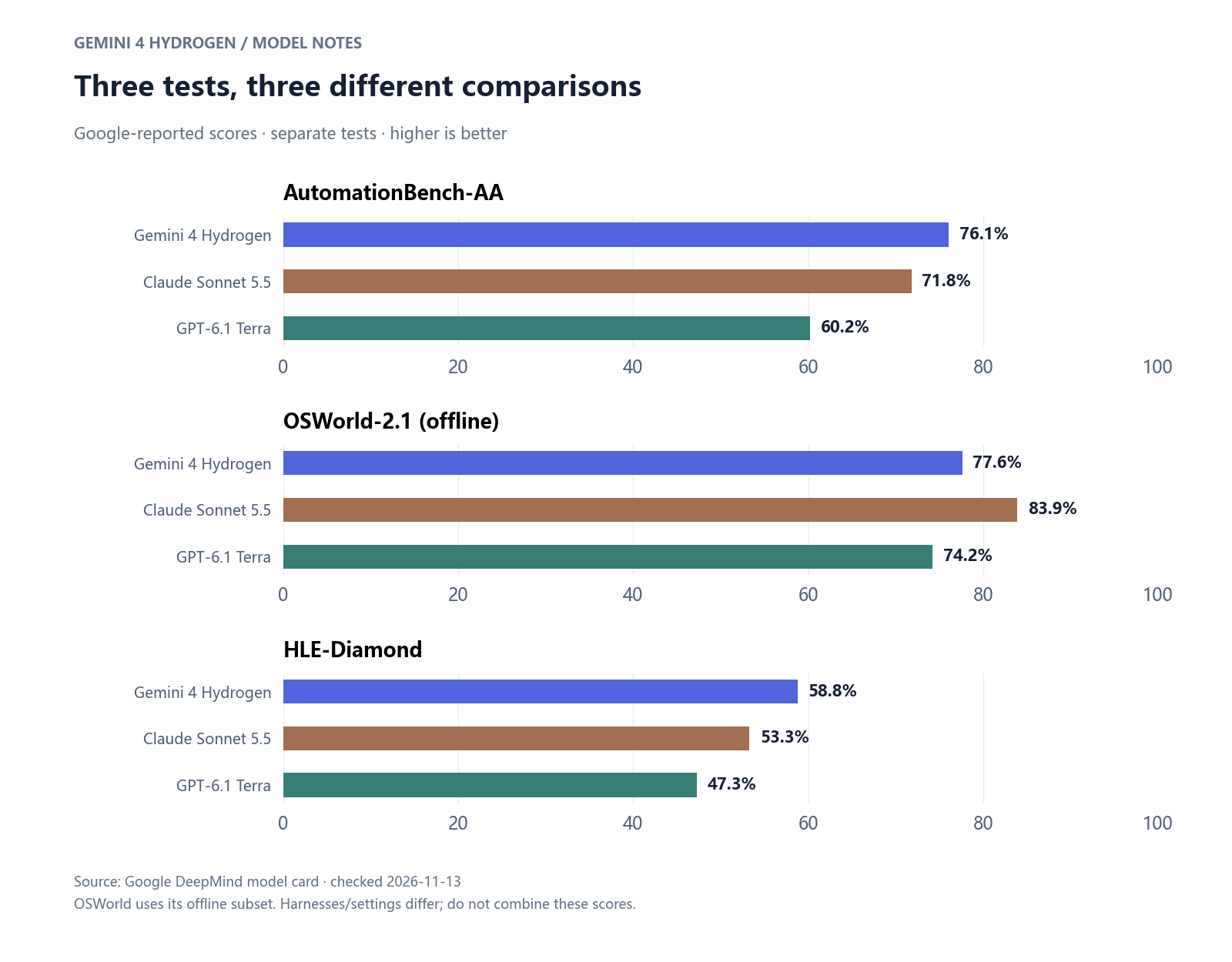
The coding comparison has another counterexample: on cheating-adjusted Terminal-Bench 4.1, Hydrogen scores 57.0% against Sonnet 5.5's 63.9%. Terra has no reported result in that cell; missing data is not a zero. Terminal work, repository repair and desktop interaction should not be treated as interchangeable tests. Google performance table · Methodology
I would use these numbers to choose a shortlist. The next decision belongs to representative tasks, consistent tools and clear acceptance criteria. A leaderboard cannot tell me whether an agent will respect a particular repository's conventions or recover gracefully from an unreliable service.
A perfect analytics run is encouraging, within its limits
Hydrogen earns a perfect score in Plotly's DataAnalyticsBench, without being the fastest or cheapest perfect scorer. That is more useful for choosing a model than the score alone. Plotly's report
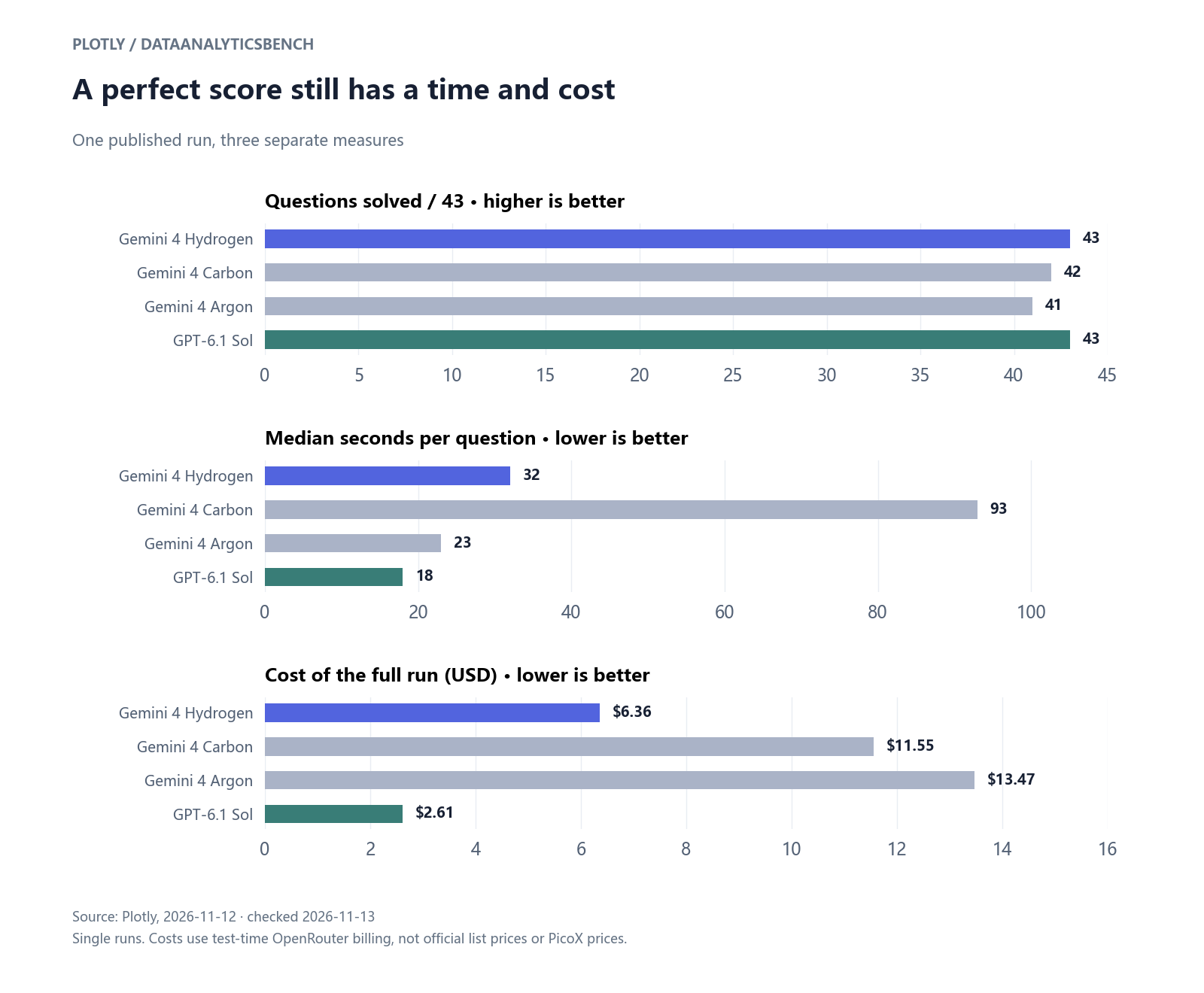
The exam uses a synthetic wind-energy warehouse and the Plotly Studio Embedded harness. It includes ambiguous questions, data-quality problems and statistical traps, which makes it relevant to tool-assisted analysis. It remains a particular dataset and tool environment. Benchmark design
Plotly also cautions that repeat runs of other models moved by up to three questions. A one-question lead should therefore stay a modest claim. In a trial, I would care more about whether an agent notices duplicate records or a misleading denominator than whether it can repeat a polished summary.
A million-token window is a shared budget
Google Cloud documents a shared 1,048,576-token allowance for input and output, with thinking and function calls included in output. A normal foreground segment, streaming or non-streaming, generates at most 65,536 output tokens. Longer generation requires Google's continuation mechanism and still has to leave room for the input. Cloud release notes
That distinction matters when integrating a model through a gateway. Increasing a token parameter does not establish continuation support. Check the actual route and client, inspect finish reasons, and budget for the material you send as well as the answer you hope to receive.
| Item | Practical reference |
|---|---|
| Google model ID | gemini-4-hydrogen |
| PicoX model ID | google/gemini-4-hydrogen |
| Shared context | 1,048,576 tokens |
| Standard foreground output | 65,536 tokens, including thinking |
| Thinking levels | low, medium, high (default), xhigh |
| Input and output | Text, image, audio and video input; text output |
| Parameter count | Not disclosed |
Specifications: Google model documentation. Supported input types also depend on the selected route and API.
The price is simple; task cost is less so
Google's Standard Gemini Developer API rates at the time of checking are below, in USD per million tokens. Output includes thinking; current context caching is implicit. These are not Batch, Flex or reseller prices. Official pricing
| Billing item | Per million tokens |
|---|---|
| Input | $1.50 |
| Cached input | $0.075 |
| Output, including thinking | $7.50 |
For a hypothetical request with 100,000 uncached input tokens and 10,000 billed output tokens, the arithmetic is 0.1 × 1.50 + 0.01 × 7.50 = $0.225. If all of that input qualifies for cached-input billing, the total becomes $0.0825. Neither example includes separately charged tools or assumes a guaranteed cache hit.
I would record the cost of an accepted task, including retries, alongside elapsed time and manual repairs. A low price per token does not rescue a workflow that repeatedly needs to start over. Nor does the highest reasoning setting automatically pay for itself on a straightforward edit.
Check the migration details before changing the model name
Google's migration guide calls for thinking_level instead of thinking_budget, and Hydrogen does not support MINIMAL. The sampling parameters temperature, top_p and top_k have no effect. Multi-turn tool use also needs correct preservation of thought_signature. These are native Google API rules; compatibility-layer mappings need their own check. Migration guide
My trial would start at the default setting with a small set of tasks whose outcomes are already known. Compare low and medium on routine work, then try xhigh where the extra effort has a clear purpose. Inspect the diff and test results for coding; verify calculations and references for analysis; deliberately include failed tool responses. Keep the ordinary cases, not just the best-looking demonstration.
Hydrogen belongs on a shortlist for everyday coding, analysis and tool-driven agents. Whether it earns a permanent place depends on how much waiting and repair it removes from your own workflow.
PicoX has added Gemini 4 Hydrogen as google/gemini-4-hydrogen. Sign in to the console model page to check the providers and integration details available to your account, then follow the API documentation to set up a client. Use the prices and route availability shown in your account.